

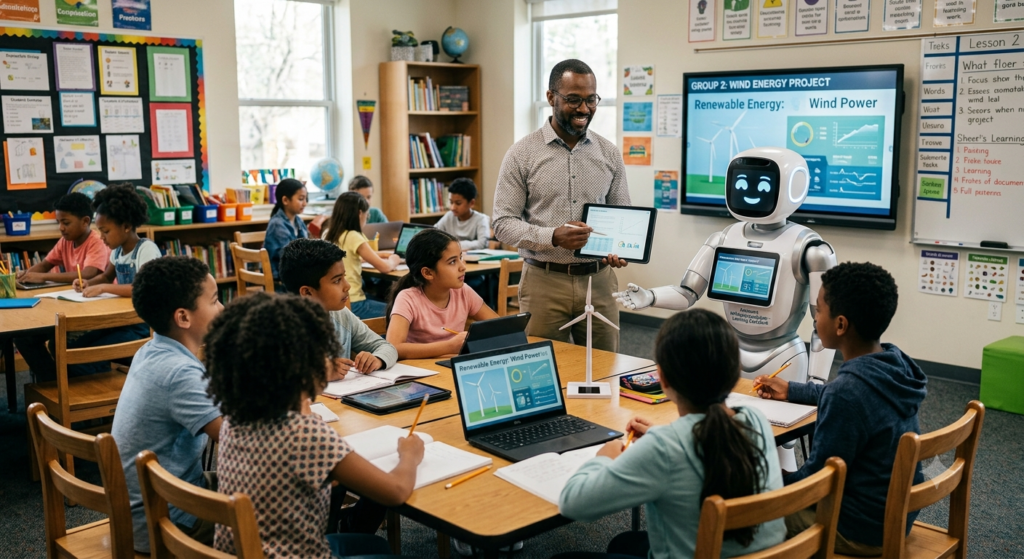
Yes, we’ll still need teachers in the classroom. Robots can’t deliver the human connections that the classroom requires. So, teachers are still very much relevant.
However, there is the other side of the story. The demand for teachers will decline.
AI can do part of the teachers’ job, such as delivering content, providing personalized learning experiences, and answering all types of questions, no matter how irrelevant they sound.
The role of teachers will change from that of subject matter experts to coaches and mentors, and that will no longer require all of us to be in the classroom.
China is now introducing AI as part of the school curriculum from age 6, according to Al Jazeera’s TAKE podcast.
What that means is that these kids will now know what AI can do from a young age and how they can harness it to their learning advantage.
Therefore, students can now turn to AI to answer most of their academic questions.
One teacher supported by AI may eventually teach more students than today. And that is where the issue is.
LearnLM Team, Google, and Eedi conducted research involving 165 students in the UK. The research was aimed at understanding whether generative AI might help in expanding access to one-on-one tutoring.
They found that students guided by LearnLM (AI) performed at least as well as students chatting with human tutors on each learning outcome they measured.
In fact, students who received support from LearnLM were 5.5 percentage points more likely to solve novel problems on subsequent topics (with a success rate of 66.2%) than those who received tutoring from human tutors alone (a rate of 60.7%).
So, AI is already making a big shift in the education industry, and we need to understand the scale so we can adapt. It’s no longer time to sit on the fence and assume things will return to normal.
For instance, the World Economic Forum reported that the UAE Ministry of Education co-develops an AI-powered virtual tutor to enhance personalized learning, aiming to improve academic performance and promote educational equity across diverse student populations.
The same report also features how Kabakoo Academies in West Africa harness AI-enabled virtual mentors to provide personalized learning experiences and mentorship, preparing young people for self-employment in informal economies.
These are powerful signals that things will not remain the same.
WHAT MIGHT HAPPEN EVENTUALLY
The strongest research does not predict the end of teachers. Instead, it suggests that AI will automate many routine teaching tasks, reduce the need for some tutoring and administrative roles, and enable each teacher to support more students.
This means education systems may eventually require fewer teachers for routine instruction while placing greater value on teachers’ uniquely human roles, such as mentoring, motivation, creativity, and social-emotional support.
HOW IS THAT A GOOD THING?
Even when AI captures a good fraction of the teacher’s role, there will still be a need for well-trained and highly specialized teachers.
The teaching role will be redefined, and as a result, only a few teachers who meet the requirements will remain. As a result, the entry requirements will be high, thereby increasing the value of the teaching profession.
At that time, we will find out how important it is to have teachers in the room, and by extension, we’ll respect them more and pay them better. The equation is that simple.
AI + SPECIALIZED TEACHER = MORE VALUABLE TEACHING PROFESSION
WHAT SHOULD TEACHERS BE DOING NOW?
The answer is simple. To stay relevant and be part of the pioneering profession that will adapt to AI, you have to build your skills.
This time, you have to build those skills that AI can’t replace, as well as the skills needed to integrate AI into the classroom. This time, there are no shortcuts and no room for mediocrity; you have to be skillful. Sorry, I wish I could say it better.
Skills such as interpersonal relationships, communication, emotional intelligence, mentoring, motivation, adaptability, etc., are some of the skills you have to master to stay relevant.
In addition, understanding how AI works, how students can learn effectively and ethically with AI, the limitations of AI, assessment, and data analysis with AI are some of the skills you will need to build.
HOW DO I GET STARTED?
You don’t need a specialized tool. Simply create a learning pathway for career reskilling for yourself using generative AI. Fine-tune it to suit your specific needs and follow the recommendations.
Also, try to implement the skills one after the other from now on to see how they work in real life. Finally, document your new skills in a portfolio so you have something to present when the need arises.
In conclusion, teachers can no longer sit on the fence. They have to participate in the change.
While no one can say for a fact how and when all of this will settle, preparing yourself to stay relevant isn’t a bad idea.